

In the past three months, I’ve seen five people through my Instagram get engaged. I hurriedly scroll through the stories—promotions with three confetti emojis, office door nameplates, new keys in front of paint swatches. I click on someone’s username and I immediately focus on a ring catching light as hands cut white cake. They say that we compare our behind-the-scenes to everyone else’s highlight reel, but I can’t help but wonder when it’ll be my turn.
Lately, the phrase “in my becoming” repeats in my mind and physically takes space in my life. I read it while going through social media accounts, hear it in well-meaning conversations, and I’ve even written it in the margins of my own books. I meant it kindly, but one thing I’ve learned through the years is that kindness easily curdles into excuses, and I’ve noticed myself deferring the ordinary work of living, holding my real life just out of reach, always one more season of preparation away because, after all, I’m still “in my becoming.”

I spend late nights rewriting plans and improving myself. I show up consistently, even if it doesn’t photograph well. My efforts just don’t stack into visible milestones easily. I have no scratched dutch oven from years of cooking the same sauce; no Christmas party certificate taped to the fridge until the tape yellows. My accomplishments hover, weightless as a half-formed thought.
Social media is difficult because it builds comparisons. Everyone’s posts are indicative of a fulfilled life. Captions like “finally home” or “new chapter” are curated highs that trigger my impatience. When will my page fill in? When will I become?
I’ve always believed in a clear ending. There is a fixed beginning, middle and end in stories, after all. What took me from one point to another was productivity. Funnily enough, even though I was a Type B, I made my own unique productivity system measured by exhaustion. I measured the value of a day by the depth of my fatigue. Tired meant progress and rest meant failure, a secret shame that no one else could see but weighed on me regardless.
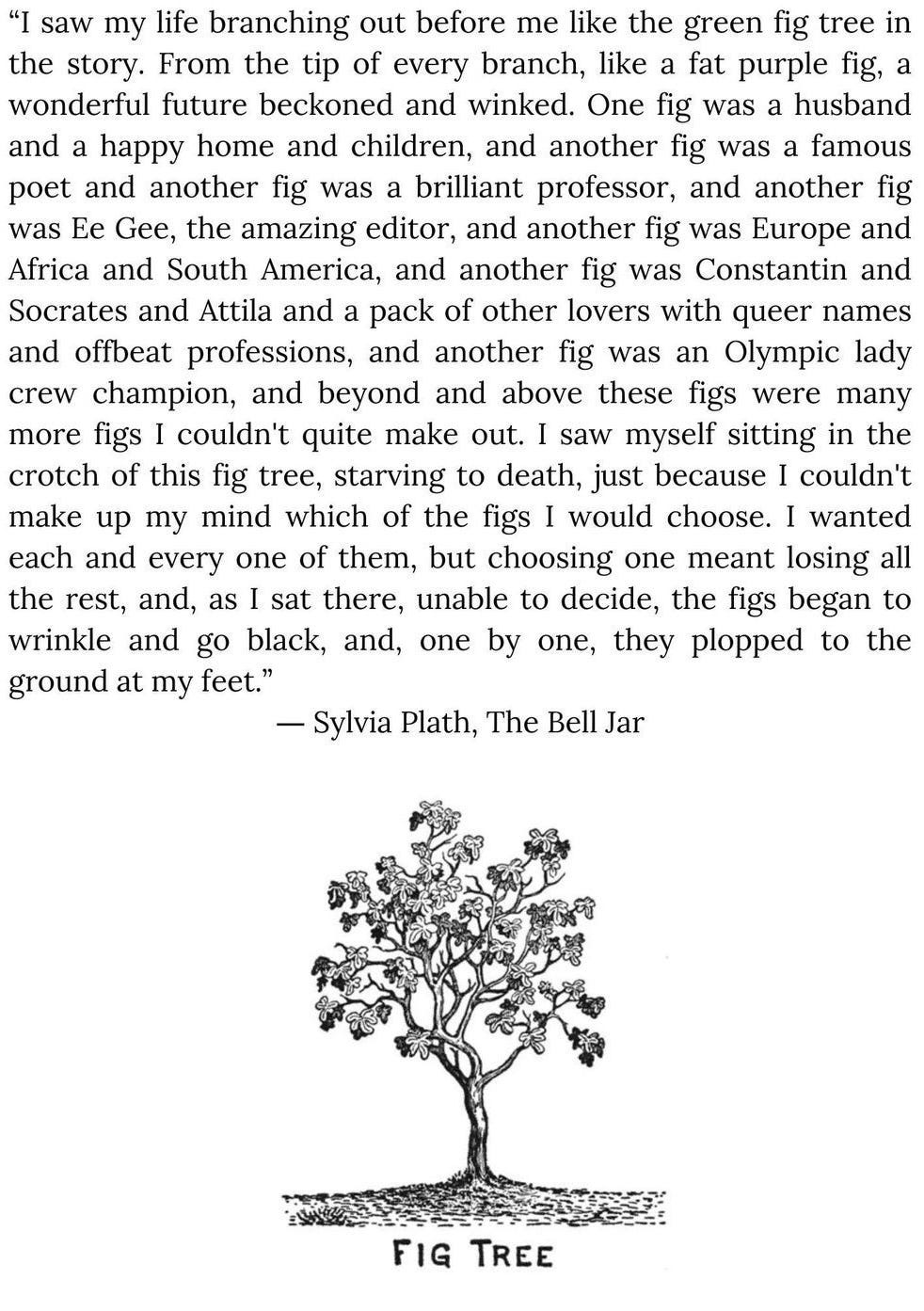
When I was younger, I read Sylvia Plath’s The Bell Jar and found solace in the fig tree metaphor. The girl sits beneath it, staring up at the branches heavy with fruit. Each fig was a possible life. The writer, the wife, the traveler, the brilliant solitary self–she cannot choose, so she waits. The figs blacken and drop, soft thuds in the grass. I did not feel the full drama of her despair as I was too young, but I was all too familiar with that sort of paralysis. The terror that choosing one path would murder the others, that if I held still a little longer, the largest, juiciest fig would ripen into view.
So I waited. I optimized. I prepared for a life, but I never actually began.
Even now, the conditional tense slips in uninvited. When I finally submit my Master’s thesis. When I fit into the jeans I’ve been keeping in the bottom drawer. When I’m fully fluent in Spanish. I could be sixty, gray-haired and still saying it, still describing myself as a project nearing completion.
I won’t lie. I’m still anxious and insecure. I’m still not fully-formed as an adult, even after all the conversations with friends where we circle the same talking points, as if one of us could stumble upon a band-aid to cover our scars. The smallness of my life, compared to everyone else’s, still haunts me. I don’t have answers, but I have a poem.
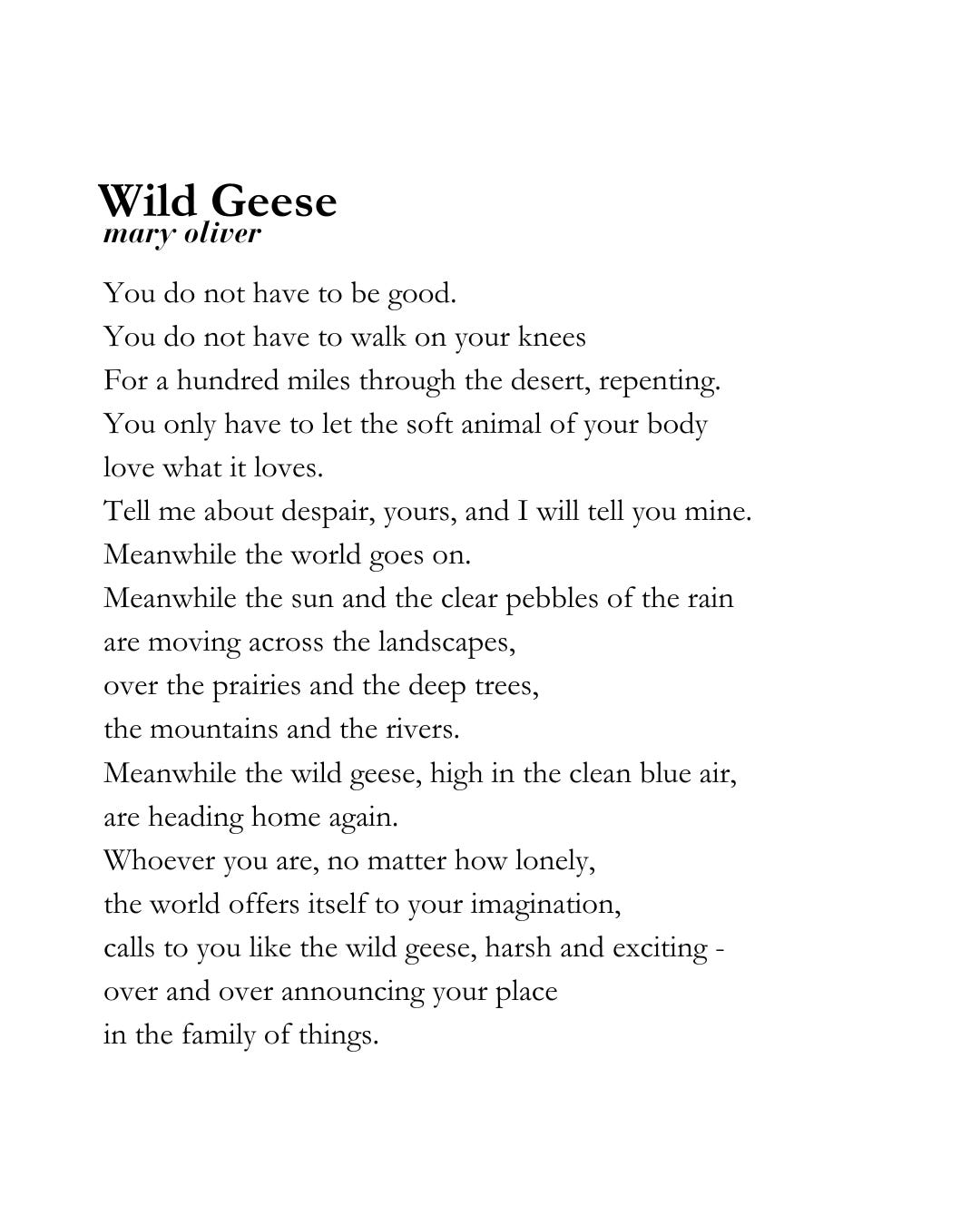
My favorite poem changes every day, but many days it’s Mary Oliver’s “Wild Geese.” Its opening line changed my life: You do not have to be good.
As the years go by, it resonates more strongly than ever. Under its light, a few things have become clear:
Nothing makes perfect sense until it’s behind you. Just fumble along, do your best, and let the understanding come later.
Waiting for the perfect moment (more money, the right job, the ideal conditions) doesn’t save you. You might get them, and then you want something else. Waiting doesn’t end, so what are you even waiting for?
Almost no one ever feels completely ready. Confidence doesn’t arrive fully dressed at your door. The only way forward is to step out even when you’re frightened.
With time, you see how often you were wrong; how many times you could have been kinder, more patient, more empathetic. My regrets pile up like old books on a shelf, and yet, as Oliver reminds us, you do not have to be good. All we can really do is forgive ourselves, let our mistakes teach us, and carry a handful of lessons forward so we can arrive at each new one a little wiser.
I no longer try to keep every fig on the tree. I have already picked one life. It’s not perfect, not final, but I am living it. The homework is late sometimes. The meals are often simple. The hours at work bend and stretch unpredictably. Happiness is not a place I reach and then inhabit forever. It is a good cup of tea gone cold, something I notice amid the ordinary. I feel it in the calm of sitting in a room that looks stripped of belonging, but mine all the same.
Mary Oliver’s Wild Geese continues: You only have to let the soft animal of your body love what it loves.
I used to think the point was becoming. Now I think the point is allowing myself to be here, in the body and the life I actually have, without the constant negotiation for a better one.
i feel so seen. thank you so much for writing this.
You write so good. Touched my heart.